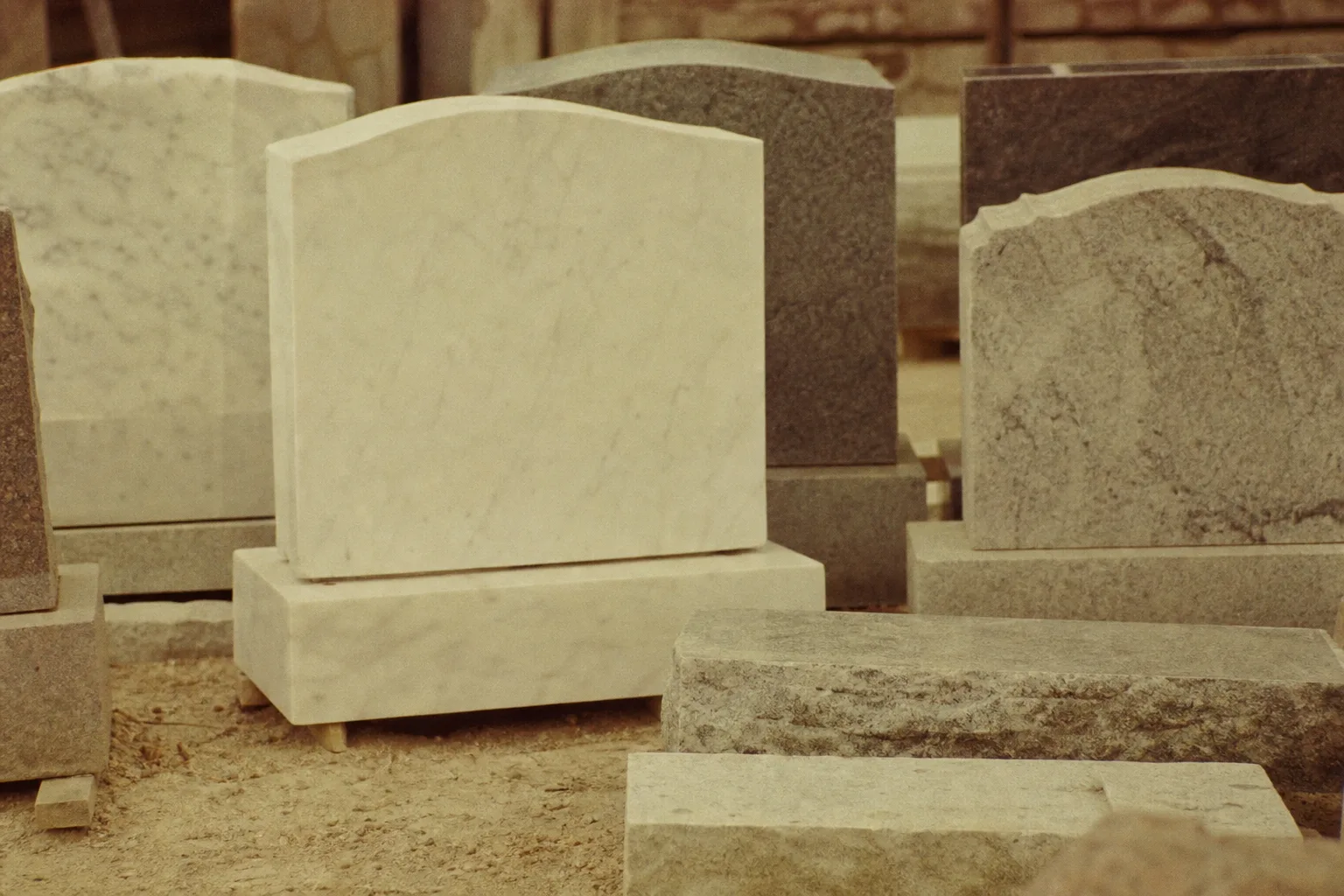
One monument order followed all the way through, from the cemetery office to the dealer to the crew that poured the foundation, with the figures and rules that came back at each step.
The order sheet a monument dealer puts in front of you settles two different questions at once: what the stone looks like the day it is set, and what it looks like in 2075, when the person reading it is somebody who never met the deceased. Those questions have different answers. A polished black granite with a fine script cut shallow will photograph beautifully and be hard to read from six feet away in a generation. A careful reader checks the material, the depth of the cut, and the arithmetic of the second name before anything is ordered, because all three are cheap to decide now and expensive to revisit.
1. Granite, and how the color choice ages
Granite is the default in American cemeteries because its quartz and feldspar do not dissolve in rain the way carbonate stone does, and a hundred-year-old barre gray marker will usually still hold its letters. What does change is the finish. A polished face slowly loses its mirror where the weather hits it hardest, most often the south and west, and the contrast between polished field and frosted letter narrows as it goes. Darker stone shows that loss sooner than mid-gray. Ask the dealer where the granite is quarried, whether the polish is machine or hand, and how the same color has held up in that cemetery.
2. Marble and limestone answer to the air, not the calendar
Marble and limestone are calcium carbonate, which means rainfall that is even mildly acidic takes a little of the surface away every year, a process masons call sugaring because the stone goes grainy under a thumb. The Environmental Protection Agency is the federal body responsible for tracking acid deposition, and monument dealers in industrial and high-rainfall regions have watched what it does to soft stone for decades. Marble also holds moisture, and in a freeze-thaw climate the water in a cut letter expands and lifts the edges. Marble is beautiful and it belongs to a certain period. It is not a fifty-year lettering decision in the Northeast or the Upper Midwest.
3. Bronze, and the base underneath it
A cast bronze plate carries raised letters, which is the most legible arrangement there is, because the reading depends on shadow rather than on the color inside a groove. Bronze also patinas, going from brown to a dull green, and the raised letters stay bright longer than the recessed background because mowers, shoes and hands keep polishing them. What fails on a bronze marker is rarely the bronze. It is the granite or concrete base, which can settle in clay soil or heave in frost, tipping the plate out of level and letting water pool in the recesses. Check what the base is, how deep it sets, and who is responsible if it settles.
4. Depth and contrast do the reading, not size
Sandblasted lettering is cut to a stated depth, and that number belongs on the order sheet in writing rather than in conversation. Shallow work looks identical to deep work on delivery day and disappears first, because a shallow groove holds less shadow and fills with lichen, dust and mower residue sooner. Serif faces with heavy stems survive better than fine script, whose hairlines are the first strokes to close up. Laser etching on polished black granite is the shallowest option of all, essentially a surface treatment, and it is best treated as decoration alongside cut letters rather than as the inscription itself.
5. The second name, and what lettering a standing stone costs
A companion monument set with one name and one date leaves work to be done later, and that work is priced differently from work done in the shop. On-site lettering means a crew, a compressor, a rubber stencil cut to match the original layout, and a trip to the cemetery, so the travel and setup are usually a larger share of the bill than the letters. Adding a closing date to a name already carved is the cheapest version. A full name, dates and a line of text is closer to a small order in its own right.
Two things reduce the surprise. Ask the dealer, at the time of the first order, to quote the second inscription and to keep the layout, font and stencil on file, and ask the cemetery whether on-site blasting is permitted or whether the stone must be pulled and returned. Some cemeteries require the latter, which adds a lift and a reset. Getting both answers in writing while the first stone is being ordered costs nothing.
The stone that reads well in fifty years is usually an unremarkable one: a hard granite in a mid tone, a stem-heavy face cut deep enough to hold a shadow, a base set below the frost line, and a written note in the dealer's file about how the second name will be handled when the time comes.